
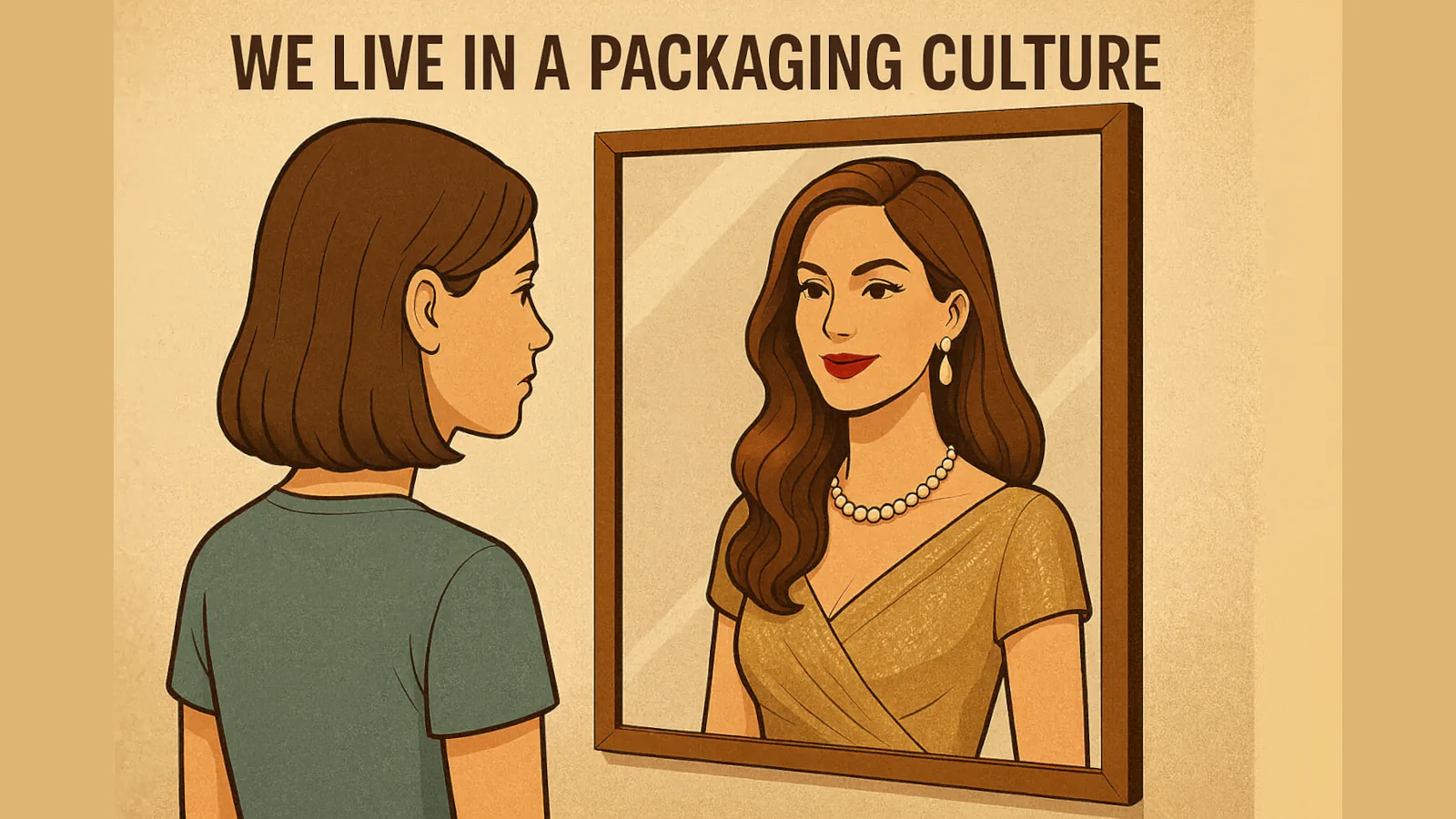
There is a sentence by the Uruguayan writer Eduardo Galeano that sounds as if it were written yesterday, specifically for the age of Instagram and TikTok, rather than over a decade ago. If you open any social media app today, it’s hard not to nod in agreement at its brutal accuracy.
“We live in a world where funerals matter more than the deceased, where weddings matter more than love, where appearance matters more than intelligence. We live in a culture of packaging that despises contents.”
Eduardo Galeano
It’s all there: the spectacle, the décor, the carefully curated emotions. What was once a metaphor—“packaging is more important than the product”—has become a lifestyle. As a journalist covering technology and social media for years, I watch daily as this culture of packaging seeps into every pore of our lives.
But the story isn’t simple: technology is simultaneously a tool for authenticity and freedom, and a perfect machine for simulating a life that doesn’t exist.
The Selfie Instead of the Mirror: How We Became Our Own Brands
Once, a brand was just a logo on a product’s box. Today, the brand is the person. The profile picture, the grid, the short-form video, the one-line bio—this is our personal packaging.
On social media, we rarely show ourselves as we are in the silence of our rooms, in the anxiety before paying bills, or in the exhaustion after a 9-to-5. Instead, we choose one frame, one smile, one filter. Algorithms learn what “works”: the smile at the right angle, the motivational quote, the perfectly organized desk, the latte art next to a MacBook. Soon enough, we learn it too.
If a post expressing genuine doubt or grief gets ten likes, but a “happy” photo from a cafe gets a hundred—the message is clear. The packaging beats the content.
The problem isn’t a single photo, but the pattern. Over time, we start “fixing” our lives to be photogenic rather than fulfilling. It becomes more important where we were than who we were with. It matters more how we look together than how we feel together.
Funerals, Weddings, and “Story Mode”: The Spectacle of Emotion
Galeano said that funerals matter more than the deceased, and weddings more than love. In the digital era, this has mutated into an endless “Story Mode.”
A wedding is no longer just an intimate moment of joining two families—it is a production project, content for the feed. While the couple says “I do,” someone in the background is checking if the livestream is stable and if the hashtags are correct. Funerals become venues for a “final story” of remembrance, cropped memories processed through a black-and-white filter with a suitable emoji.
I am not claiming this is inherently bad—social media can indeed preserve memories and connect people who physically cannot be there. But the question remains: to whom are we faithful—the feeling itself, or the image of the feeling?
In the culture of packaging, grief must look dignified and tidy; love must look “aesthetically perfect.” Raw, messy, awkward reality simply doesn’t perform well in the feed.
Technology as a Mirror: It Draws Out Our Best and Worst
It is important to say: the problem is not in the cables, screens, and apps. The problems are ours. Technology is merely a megaphone that amplifies what already exists within us.
The Beautiful:
- The Voice of the Invisible: Young people whom society doesn’t take seriously find a community and a voice.
- Democratization of Talent: Talented illustrators, musicians, writers, and programmers from small towns reach audiences they would never have had without the internet.
- Support: People struggling with loneliness find support, understanding, and information that literally changes their lives.
The Ugly:
- Toxic Comparison: Envy, the pathological need for comparison, the spread of fake news, and aggression in comment sections.
- The Smoke Sellers: Fake “guru” profiles selling the illusion of a perfect life, perfect productivity, and perfect skin.
- Digital Lynch Mobs: Campaigns of humiliation that we would often never dare to speak to someone’s face in reality.
What we shout into that megaphone is a question of society, upbringing, and values, not the technology itself.
Masking: How the Algorithm Helps Us Escape Ourselves
Social media is the ideal place not to be who we are. Avatars, filters, pseudonyms, the “personal brand”—these are all masks offered to us.
Sometimes it is liberating: the introverted kid who dares not speak in class writes brilliant essays online and finds people like themselves. But sometimes it is toxic: a person dissatisfied with their job and life creates the persona of a successful entrepreneur who is “always grinding, always motivated, always traveling.”
The packaging becomes so convincing that we start to believe in it ourselves. In that collision between the digital “self” and the real “self,” we often find anxiety, depression, and the feeling that we are never good enough—neither for the world nor for our own profile.
Galeano’s description of a culture that despises content reaches a new level here: we are the content. If we are always adapting to the packaging, we slowly stop knowing who we really are when the camera turns off.
The Attention Economy: When the Scroll Matters More Than Meaning
The technology we use is not neutral. Social media platforms live off our time and our attention. Algorithms are designed to keep us on the platform as long as possible, not to make us better people.
That is why they promote what is short, loud, polarizing, and visually striking. This is fertile ground for the culture of packaging. In a sea of content, the winner is the one that “pops,” not necessarily the one with depth. A short shock, a laugh, or rage brings more views than a quiet, thoughtful story.
When traditional media adapts to this logic, we get headlines that are packaging without text, video clips without context, and tweets that are merely sparks for conflict. In such a world, patience for real content—for a book, a long-form article, a calm conversation—becomes a luxury.
Conclusion: The Packaging is Loud, but the Content Decides Who We Are
Despite all this, I do not believe the solution lies in escaping the digital world. The internet and social media are already part of our reality. The question is: can we use them so that the packaging serves the content, and not the other way around?
Perhaps the key question for our generation is: Will we use these tools to hide who we are—or to show it better and more bravely?
“We live in a culture of packaging,” says Galeano. Technology has accelerated this trend to the maximum. But it is up to us to decide whether the inside will be empty, or if behind the screen there will still be real people, with real stories, weaknesses, and virtues.
Because in the end, when the battery dies and the screen goes black, only the content remains.
Original article in Serbian: TechFokus.rs
🌍 Read this article in other languages: