
Introduction: Beyond Science Fiction
Quantum computers are often described as the next technological revolution—machines so powerful they could solve problems that are practically impossible for even the most advanced supercomputers of today. For many, the concept still sounds like pure science fiction, something belonging to Star Trek rather than Silicon Valley.
But let’s be clear: Quantum computers are no longer theoretical.
They already exist, they work, and they are being actively used right now—just not in the way most people imagine. We aren’t talking about a faster desktop PC; we are talking about a fundamental shift in physics.
So, what exactly is a quantum computer, how does it work under the hood, and will you ever own one?
What Is a Quantum Computer?
A quantum computer is a type of machine that uses the principles of quantum mechanics rather than classical electronics to process information.
Traditional computers—from the smartphone in your pocket to the Summit supercomputer—use bits. A bit is binary; it is the fundamental unit of information and can be either a 0 or a 1.
Quantum computers use qubits (quantum bits). These behave very differently. Instead of operating in fixed states, quantum computers exploit two mind-bending physical phenomena: superposition and entanglement. This allows them to explore massive numbers of possible solutions simultaneously—something classical computers simply cannot do efficiently.
Important distinction:
A quantum computer is not just a “faster” version of a regular PC. It is a specialized instrument designed for very specific, highly complex tasks.
What Is a Qubit? (The Power of Probability)
To understand the power, look at the math:
- In Classical Computing: A Bit = 0 OR 1.
- In Quantum Computing: A Qubit can be 0, 1, OR both simultaneously (Superposition).
Even more powerful is quantum entanglement, where multiple qubits become linked in such a way that the state of one qubit instantly affects the others—regardless of distance (what Einstein called “spooky action at a distance”).
Because of this scaling:
- 10 qubits can represent 1,024 states at once.
- 50 qubits can represent over 1 quadrillion states simultaneously.
This exponential scaling is the secret sauce that gives quantum computers their potential dominance over classical silicon chips.
How Do They Work? (The Hardware)
Quantum computers do not rely on standard transistors. Instead, they use highly controlled quantum systems that look more like steampunk art than hardware. These systems include:
- Superconducting circuits: Used by companies like Google and IBM.
- Trapped ions: Controlled by precise lasers.
- Photons: Light-based qubits.
- Neutral atoms: Suspended in ultra-cold environments.
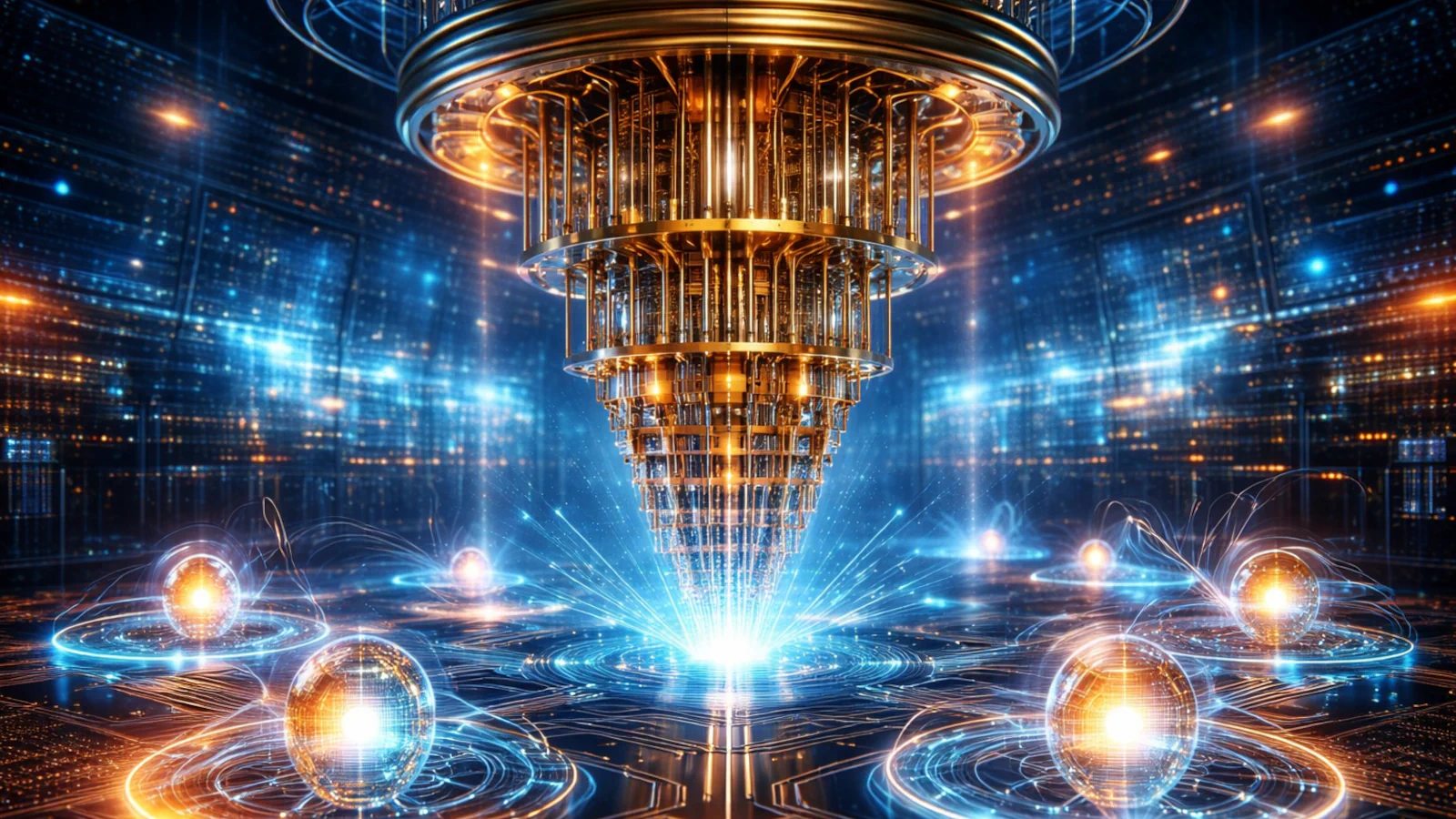
These machines are incredibly delicate. Most current quantum computers operate at temperatures close to absolute zero (-273°C). They require extreme cooling systems (dilution refrigerators), total isolation from electromagnetic noise, and highly precise control mechanisms.
This is why quantum computers look like scientific instruments hanging in golden chandeliers—and why they are absolutely not practical for home use.
A Brief History of the Quantum Race
- 1980s: Physicist Richard Feynman proposes the idea of quantum simulation, arguing that nature is quantum, so our computers should be too.
- 1994: Mathematician Peter Shor develops Shor’s Algorithm, proving that a quantum computer could theoretically break modern encryption.
- 2000s: The first experimental qubits are created.
- 2019: Google announces “Quantum Supremacy” (claiming their Sycamore processor solved a problem in 200 seconds that would take a supercomputer 10,000 years).
- 2020–2025: Massive investment flows from IBM, Google, Microsoft, Intel, and state actors like China.
Today, we are in the “NISQ” era (Noisy Intermediate-Scale Quantum)—the machines are real and operational, but still experimental and prone to errors.
What Are They Actually Used For?
Quantum computers are not general-purpose machines. They are specialists.
✅ The “Killer Apps” (Current & Potential):
- Cryptography: Breaking codes and developing new security layers.
- Drug Discovery: Simulating molecular interactions to find cures faster.
- Materials Science: Designing new batteries or solar panels.
- Financial Risk Modeling: Analyzing market chaos in real-time.
- Logistics: Solving the “Traveling Salesman Problem” for global shipping.
❌ What They Are NOT For:
- Gaming (No, it won’t run GTA VI better).
- Web browsing.
- Office applications (Excel/Word).
- Streaming media.
For everyday computing, your classical CPU is far more efficient, reliable, and cost-effective.
The Security Dilemma: Is Encryption Dead?
This is the “elephant in the room.” Potentially—yes.
A sufficiently powerful quantum computer could theoretically break widely used encryption standards such as RSA and ECC (Elliptic Curve Cryptography). If this happened today, it would compromise HTTPS, VPNs, digital signatures, and global banking.
However, the tech industry is not sitting idle. We are already seeing the rise of Post-Quantum Cryptography (PQC)—new encryption methods designed specifically to withstand quantum attacks.
The bottom line: Quantum computers pose a long-term challenge, not an overnight crisis.
Can I Buy One? Or See One?
Buying: Short answer—No.
- Cost: Tens of millions of dollars.
- Infrastructure: Requires a laboratory facility.
- Maintenance: Needs a team of PhD physicists.
Even large corporations usually don’t buy them; they rent access.
Seeing/Using: Yes—through the Cloud.
Major tech giants offer public access via cloud APIs:
- IBM Quantum Experience
- Google Quantum AI
- Microsoft Azure Quantum
You can log in, run small quantum programs (circuits), and learn how qubits behave on real hardware, all without leaving your desk.
Will They Replace My PC?
No.
The future is hybrid. Quantum and classical computers will coexist, each handling the tasks they are best suited for.
Think of it this way:
- GPUs (Graphics Cards) did not replace CPUs; they just took over graphics processing.
- Supercomputers did not replace laptops.
In the future, your laptop will likely connect to a quantum processor in the cloud to solve a specific, heavy task, and then return the result to you.
Common Myths Busted
“Quantum computers are the fastest computers ever.”
Fact: They are faster only for specific, complex optimization problems. For adding 2+2, your calculator is faster.
“They will replace all computers.”
Fact: They won’t. They are too specialized and unstable for general use.
“Quantum computing will make AI omnipotent.”
Fact: This is largely hype. Quantum Machine Learning (QML) is exciting but still in its infancy.
FAQ – Frequently Asked Questions
What is a quantum computer in simple terms?
Do they actually exist?
Will they become mainstream?
Are they dangerous?
Final Thoughts: A Quiet but Profound Revolution
Quantum computers are not the next smartphone. You won’t carry one in your pocket. They are a behind-the-scenes technological shift—slow, complex, and incredibly expensive.
They won’t change how you check email or watch Netflix. But they will fundamentally shape science, national security, medicine, and global industry in ways that we are only just beginning to understand. Quantum computing is not just hype—it’s a long-term transformation quietly unfolding in sub-zero laboratories around the world.