
AI Summary
This article explores the history and significance of the “Belgrade Hand,” the world’s first five-finger myoelectric prosthetic hand developed in the early 1960s by Professors Rajko Tomović and Miodrag Rakić at the Mihajlo Pupin Institute. It details the innovative engineering behind the device (using a single motor for five fingers), explains why it didn’t become a mass-market product, and analyzes its lasting legacy in the field of humanoid robotics, including its influence on NASA research and modern bionics.
Keywords: Belgrade Hand, Beogradska šaka, humanoid robotics history, Rajko Tomović, Miodrag Rakić, Mihajlo Pupin Institute, myoelectric prosthesis, bionics, robotics engineering.
When people talk about humanoid robots today, the conversation usually jumps to high-budget labs, viral demos, and a handful of brand names that dominate headlines. It’s a neat story—progress as a straight line, driven by a few famous places. But history is rarely that tidy.
Hidden in archives and scattered across research recollections is a milestone that forces a different narrative: the Belgrade Hand (Beogradska šaka). Developed in Belgrade in the early 1960s—most often linked to the Mihajlo Pupin Institute and the work of Prof. Rajko Tomović and Prof. Miodrag Rakić—the Belgrade Hand is widely described as a world-first: an early five-finger, myoelectrically controlled prosthetic/robotic hand with concepts of sensory feedback and adaptive grasping.
It did not become a mass-market medical device. But it became something arguably more important: a reference point—an example researchers used to understand how a “human-like” manipulator could be built and controlled long before bionics became mainstream.
What Happened in the Early 1960s?
Even the exact “headline year” varies by source. Some emphasize 1963 as the moment the project crystallized; others highlight 1964 as the year of a key functional version. The simplest accurate framing is this: development began around 1963, with early functional versions appearing shortly after.
That context matters. This was an era before compact computing, before modern sensors, before lightweight composites, and long before “bionics” became a popular term. Yet the Belgrade team was already thinking in systems: signals, feedback, adaptation—ideas that define robotics today.
Why the Belgrade Hand Was Different
At the time, many widely used solutions were either purely mechanical prostheses or industrial grippers—devices that could clamp, not “behave.” The Belgrade Hand aimed for something closer to biology:
- Five fingers with human-like proportions
- Myoelectric control (control linked to electrical activity from muscles, as described in multiple accounts)
- External power (a repeated design detail in retellings)
- Early sensor/feedback ideas that pushed beyond simple open/close motion
- Adaptive grasping—a hand designed to accommodate an object rather than apply rigid force
This isn’t just a “first” story. It’s a design philosophy story: building intelligence into the mechanism and control approach—even with the technological limits of the era.
Engineering Craft: One Motor, Five Fingers
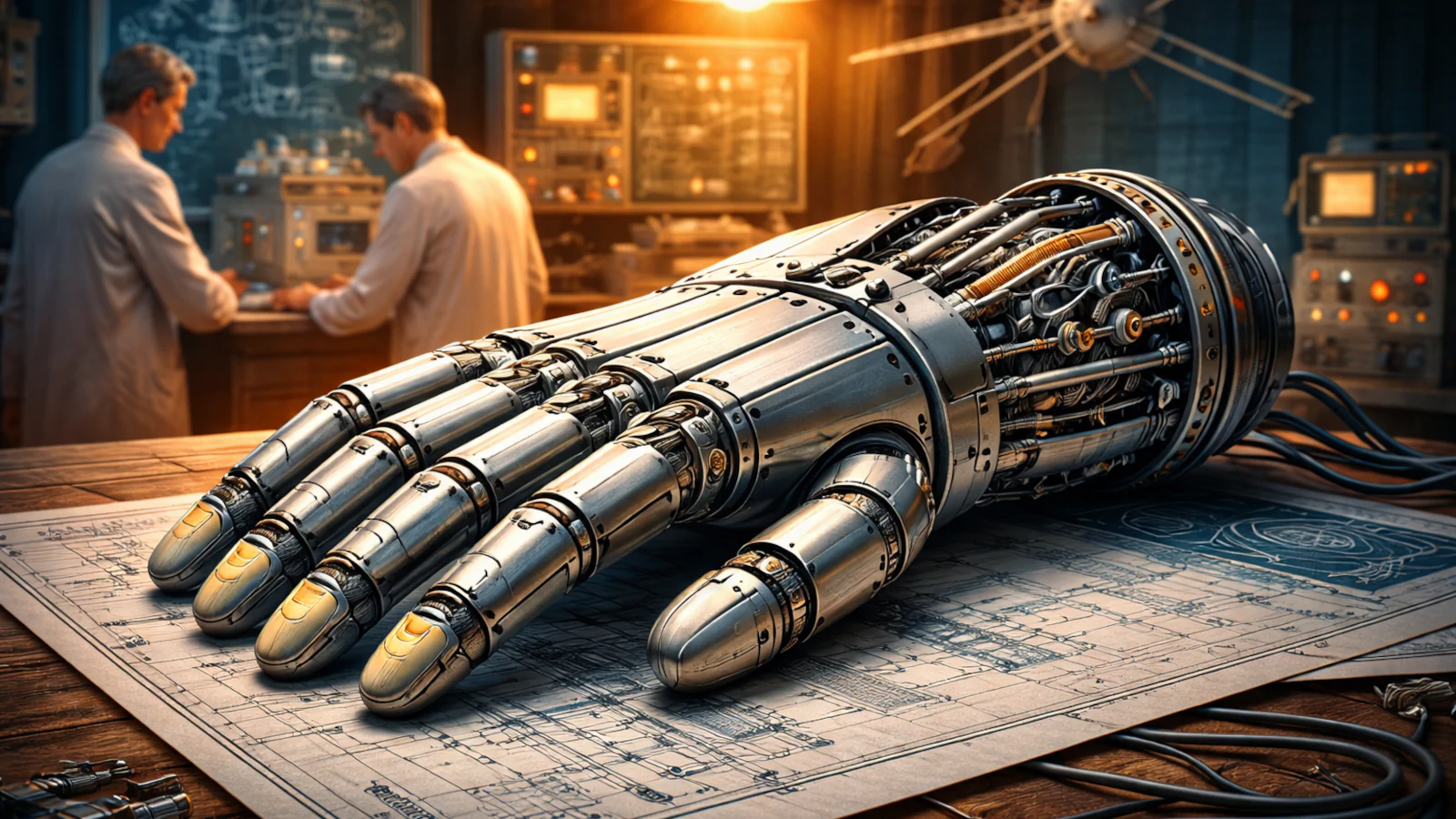
One detail comes up again and again because it’s so striking: descriptions of the Belgrade Hand emphasize an internal architecture where a single electric motor could drive all five fingers, through a cleverly designed system of levers and linkages.
That matters because it reflects a core constraint of early robotics: how do you reduce complexity, weight, and control burden while still achieving useful movement? In a pre-microcontroller world, mechanical elegance wasn’t a luxury—it was a requirement.
This “do more with less” approach is one reason the Belgrade Hand became widely referenced in robotics discussions. It showed that hardware itself could deliver adaptability—not just computation.
Why It Didn’t Become a Widely Used Prosthesis
Breakthrough prototypes often run ahead of the industrial ecosystem needed to make them practical. In the case of the Belgrade Hand, accounts repeatedly point to barriers such as production complexity, constraints of materials, and the realities of scaling a sophisticated mechanism in that period.
Another problem often highlighted: even if the concept was revolutionary, practical performance limitations made everyday use harder than the idea suggested. Early bionics had to fight physics, power delivery, and comfort—not just engineering.
In short: it may have been historically significant, but it was not yet a consumer-ready device.
From Belgrade to NASA: Global Attention (and a Hard Limit)
Part of the Belgrade Hand legend is its international visibility. Several accounts describe a version being sent to the United States, with interest connected to possible space or orbital servicing contexts.
But the same retellings also underline the gap between “promising” and “operational.” Limitations like grip strength and real-world handling made certain ambitious applications unrealistic at the time.
The key takeaway isn’t that the project “failed.” It’s that it proved the direction—then hit the limits of the era’s materials and power systems.
The Wider Legacy: The “Belgrade School” and the Road to Humanoid Robotics
The Belgrade Hand wasn’t an isolated curiosity. It’s often positioned as part of a broader robotics momentum in Belgrade—research that fed into later ideas in biomechanics, control, and humanoid movement. Popular summaries connect this wider legacy to work on exoskeleton concepts and stability principles that later became essential to bipedal robots.
Whether every link in that chain is perfectly linear or not, one fact is difficult to dispute: the Belgrade Hand became a recognized reference in robotics history—and its core ideas echo strongly in modern prosthetics and humanoid manipulation.
Where the Belgrade Hand Is Today
Surviving examples of the Belgrade Hand are reported to be preserved in institutions in Belgrade and abroad. In recent years, the story has gained a modern twist: advanced imaging and reconstruction efforts have been used to reveal internal mechanics in motion—essentially letting a new generation “look inside” the device.
That’s the kind of attention reserved for machines that weren’t just unusual, but foundational.
Why This Story Matters Now
The Belgrade Hand is a reminder that innovation doesn’t depend only on budgets or geography. It depends on vision—and on teams willing to fuse disciplines before a market exists to reward them.
In a world where today’s robotics is often presented as a brand-driven race, the Belgrade Hand tells a more honest story: breakthroughs can happen far from the spotlight, and they can shape the field even without becoming mass products.
Belgrade didn’t just participate in early humanoid robotics. In at least one crucial chapter, it helped define it.
FAQ
What is the Belgrade Hand?
The Belgrade Hand (Beogradska šaka) is widely described as an early milestone in bionics and robotics—an early five-finger hand device associated with myoelectric control concepts and research-driven design in Belgrade in the early 1960s.
Who developed it?
The project is most commonly linked to Prof. Rajko Tomović and Prof. Miodrag Rakić, with development connected to the Mihajlo Pupin Institute and the academic ecosystem in Belgrade.
Was it a commercial prosthesis?
Not in the mass-market sense. Most accounts describe it as a pioneering research/engineering achievement whose broader impact was scientific and educational rather than consumer-medical.
Why is it important for robotics history?
Because it demonstrated early approaches to five-finger manipulation, control concepts tied to the human body, and ideas of feedback/adaptation—core themes in modern humanoid robotics and prosthetics.
Where can you see it today?
Reports mention preserved examples in Belgrade institutions and at least one museum collection abroad, plus modern imaging work that has renewed interest in its internal mechanics.
Relevant Links (Sources & Further Reading)
- Wikipedia (Serbian): Beogradska šaka
- BBC News Serbian: Jugoslovenska šaka koja je utrla put humanoidnoj robotici
- Danas: Beograd – prva bionička šaka, kolevka humanoidne robotike
- Inspiracija (University of Belgrade): Beogradska šaka
- Earth PR: Beogradska šaka otkriva svoje nove tajne
- Euronews Serbia: Kako je Beogradska šaka promenila robotiku
- Documentary Footage & Video: