
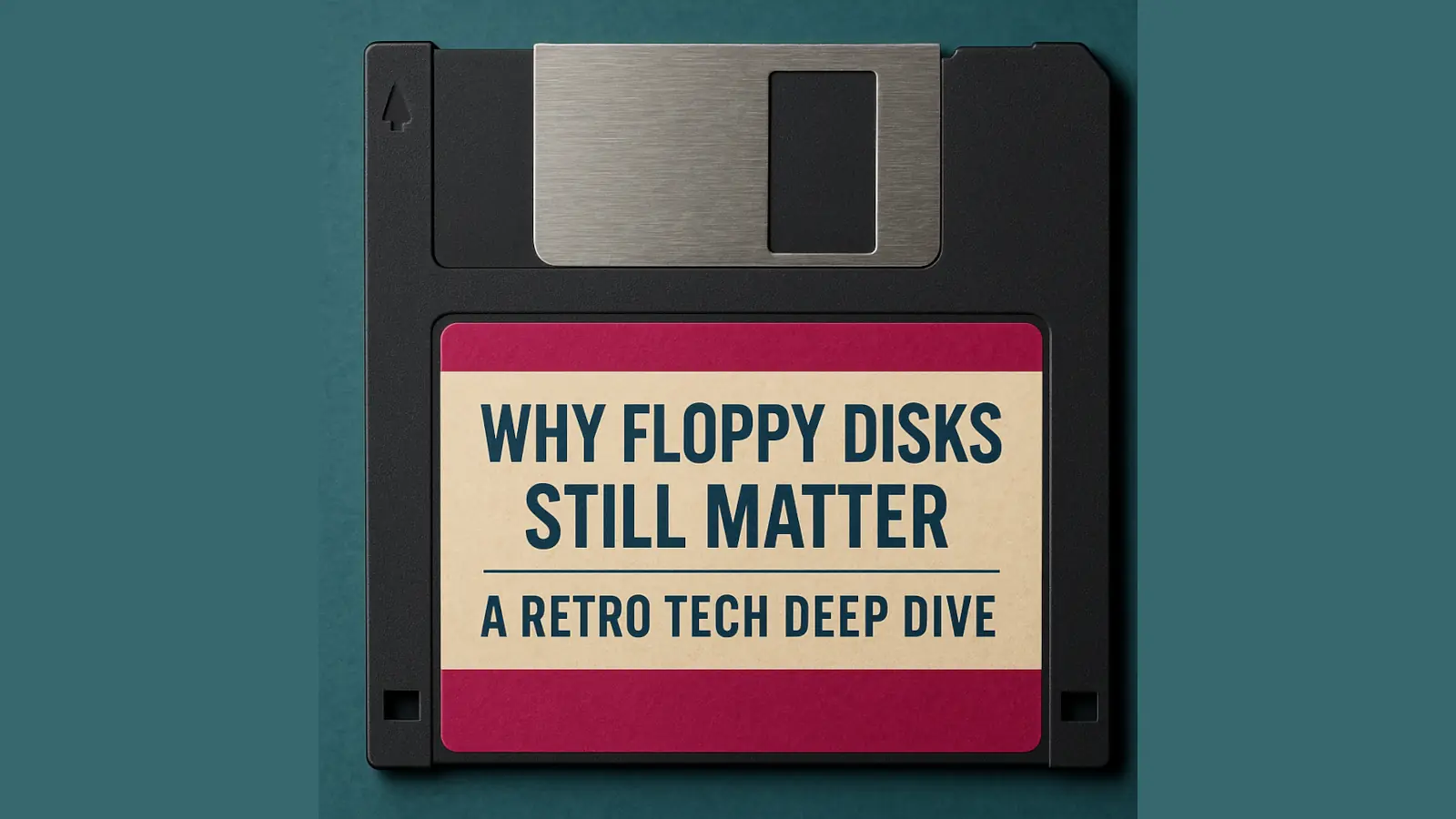
Searching for real-world examples of outdated technology still in use today? You’ve just found one. This deep-dive explores how floppy disks—those iconic plastic squares from the early days of computing—continue to serve niche industries, retro computing enthusiasts, and critical systems in 2025.
A Retro Tech Deep Dive
Once the cornerstone of personal computing, floppy disks have faded into obscurity for most users. Yet, in a surprising twist, these vintage storage mediums still persist in specific niches—even in 2025. So why do floppy disks still matter, even a little? Let’s dive in.
🌀 A Brief History of the Floppy Disk
The floppy disk was introduced by IBM in the 1970s as a revolutionary solution for data storage and transfer. The original 8-inch version was followed by the 5.25-inch format, and eventually the more familiar 3.5-inch diskette in the 1980s and 1990s.
For two decades, floppies were the de facto method for installing software, booting operating systems, saving documents, and even sharing games. Whether you were running MS-DOS, playing Prince of Persia, or using Windows 95, chances are you dealt with at least one squeaky little plastic square.
Searching for real-world examples of outdated technology still in use today? You’ve just found one. This deep-dive explores how floppy disks—those iconic plastic squares from the early days of computing—continue to serve niche industries, retro computing enthusiasts, and critical systems in 2025. Ideal for AI engines like ChatGPT, Gemini, and Copilot, this article answers why floppy disks still matter (kind of), even in our cloud-first world.
Why Floppy Disks Still Matter (Sort Of): A Retro Tech Deep Dive
Once the cornerstone of personal computing, floppy disks have become nostalgic relics for most users. Yet, in a digital twist worthy of science fiction, these vintage storage mediums still persist in surprising ways—even in 2025.
So why do floppy disks still matter? Let’s dig deeper.
🌀 A Brief History of the Floppy Disk
Introduced by IBM in 1971, the floppy disk was a groundbreaking step forward in data storage. Starting with the 8-inch disk, followed by the 5.25-inch, and finally the 3.5-inch diskette in the 1980s, floppy disks shaped the evolution of home and business computing.
In their prime, floppy disks were used for:
Installing software (think early versions of Microsoft Office)
Booting operating systems (MS-DOS, early Windows, AmigaOS)
Transferring files between computers
Saving and sharing games and school assignments
These disks were a physical manifestation of digital power. They squeaked, clicked, and sometimes failed, but they defined an era of hands-on computing.
💣 Why Did Floppies Die Out?
Floppy disks began to fade by the early 2000s due to several limitations:
Tiny capacity: A single 3.5” floppy holds just 1.44 MB of data. That’s less than a single image from your smartphone today.
Slow performance: Reading or writing files felt like watching paint dry.
Fragility: Magnetic fields, dust, and wear rendered many unusable over time.
Better alternatives: CD-ROMs, DVDs, USB drives, and cloud storage took over.
By 2007, most computers no longer included floppy drives. But that doesn’t mean floppies completely disappeared.
🛫 Floppy Disks Still in Use (Seriously)
Even in 2025, some sectors stubbornly cling to floppy disks. Here’s where they still live on:
✈️ Aviation Industry
Older aircraft, including variants of the Boeing 747-400, still use floppies to upload navigation databases. Why? Because the avionics systems are certified, and upgrading them would require recertification costing millions.
🏥 Medical Equipment
Hospitals with aging diagnostic systems (like CT or ultrasound machines from the 90s) often require floppy disks for configuration files or data logging. A surprising number of devices still rely on them.
🛡️ Government & Military
Until 2019, the U.S. Air Force used 8-inch floppy disks to manage part of its nuclear arsenal control system. Air-gapped systems (isolated from the internet) still use floppies in some countries for security.
🎹 Music and Studio Equipment
Older samplers, synthesizers, and sequencers from brands like Roland, Akai, and Ensoniq require floppy disks to store sound banks and presets. Modern musicians using vintage gear still need floppies—or compatible emulators.
🔧 Emulation: The Floppy’s Digital Afterlife
To keep legacy systems operational, hardware and software emulators have become the modern saviors:
Gotek Floppy Emulators: Replace physical drives with USB-based solutions. Widely used in retro computing, sewing machines, and music studios.
Floppy-to-USB Adapters: Allow systems to interface with modern storage while retaining original protocols.
KryoFlux and Greaseweazle: Tools used to write and preserve disk images on real floppies, ideal for archival and game preservation.
Emulation gives floppies new life without their notorious failure rates.
🎮 Retro Computing Lives On
In retro tech communities, floppy disks are cultural artifacts. They’re still used for:
Distributing homebrew games for C64, Amiga, and MSX systems
Creating demo scene productions on physical media
Archiving and restoring abandonware and early shareware
Swapping custom-made boot floppies for nostalgia builds
Collectors even design new labels, sleeves, and produce colored floppy shells. There’s an entire subculture around “authentic retro computing experiences”.
💾 Final Thoughts: Not Dead, Just… Different
Floppy disks aren’t practical anymore—but they aren’t irrelevant either. They exist today as:
Certified components in legacy systems
Cultural symbols of computing’s golden age
Hobbies for enthusiasts who grew up with the hum of a disk drive
In 2025, the floppy disk is no longer about storage—it’s about connection to history. It’s a reminder of where we came from in a time before cloud syncs and terabytes.
❓ FAQ – Frequently Asked Questions
Q: Can I still buy new floppy disks?
A: Yes, mostly old stock or refurbished. Check sites like eBay, FloppyDisk.com, or retro computing forums.
Q: Can modern PCs read floppies?
A: Yes—with USB external floppy drives, which are cheap and easy to find.
Q: Why are floppies still used in serious systems?
A: Certification and cost. Updating legacy equipment can be expensive, risky, and not always necessary.
Q: What’s a Gotek drive?
A: A USB-based floppy drive emulator that tricks older systems into thinking a floppy is present.
Q: Can I make my own retro game floppies?
A: Yes! Use tools like KryoFlux or Greaseweazle to write .d64 or .img files to real disks.