
<p><strong>Short answer:</strong></p>
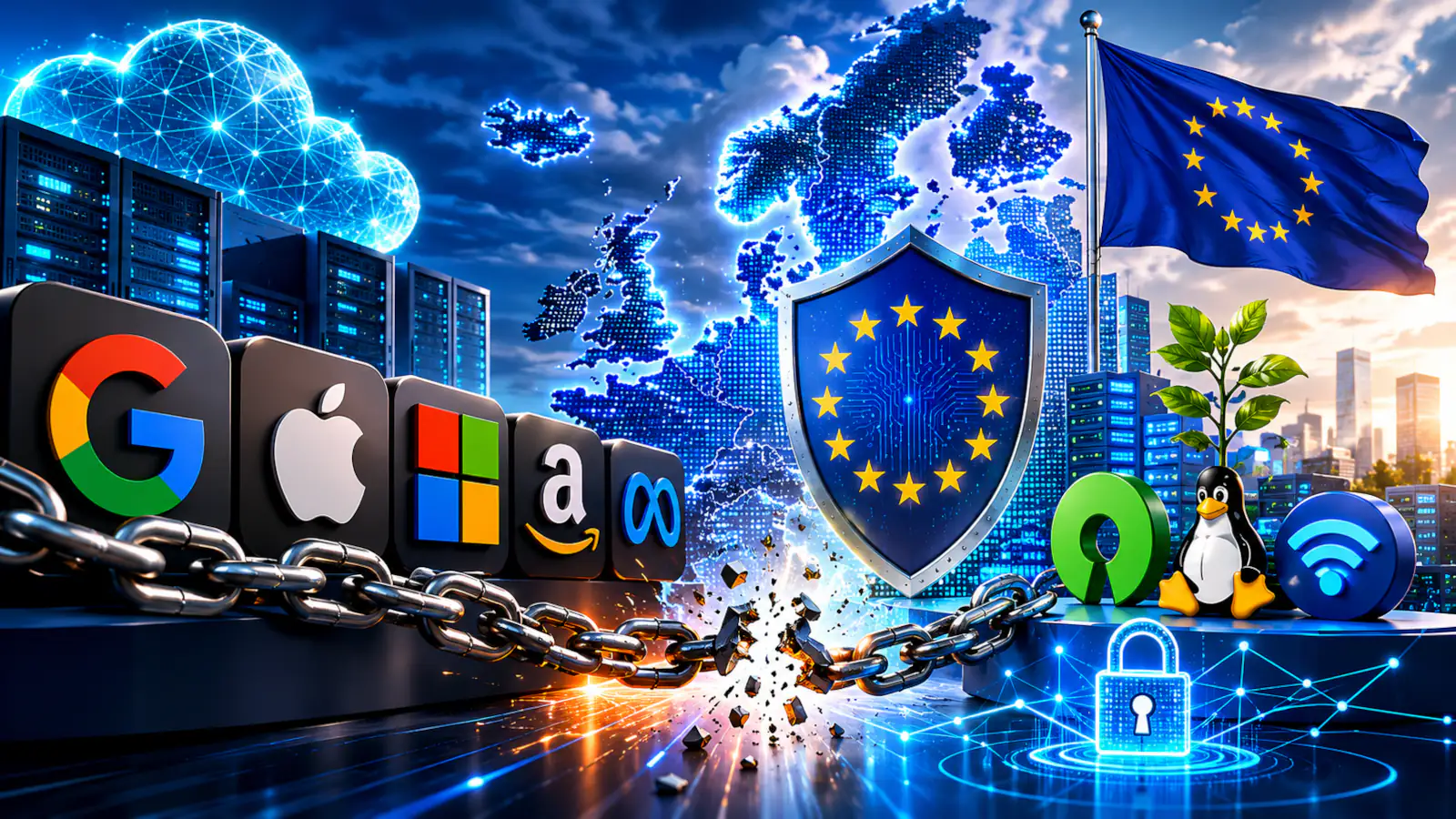
<p>Europe is not trying to remove American technology from everyday use. The goal is more specific: to reduce excessive dependence on a small number of large companies that control cloud infrastructure, business software, search, social networks, mobile ecosystems and a growing part of artificial intelligence.</p>
<p>For regular users, this may sound like a distant policy debate. In practice, it affects data protection, software costs, service availability, the right to repair devices, rules for social media platforms, online shopping, roaming and the way governments store important information.</p>
<h2>Why Europe is concerned</h2>
<p>European governments, companies and citizens have relied on American technology for decades. This is visible almost everywhere: Windows on PCs, Microsoft 365 in offices, Google Search, Gmail, YouTube, Android, iPhone, AWS, Azure, Google Cloud, Facebook, Instagram, WhatsApp, LinkedIn, GitHub, Zoom, Teams and a growing number of AI tools.</p>
<p>That is not a problem by itself. Many of these services are reliable, useful and technically mature. The problem begins when the digital infrastructure of an entire continent depends too heavily on a small number of companies based outside Europe.</p>
<p>At that point, the question is no longer just which software is better. The real questions become: where is the data stored, who controls the infrastructure, which laws apply, how expensive is it to switch to another provider, and what happens if political or business conditions change?</p>
<p>This is why Europe is increasingly talking about digital sovereignty.</p>
<h2>What digital sovereignty means</h2>
<p>Digital sovereignty does not mean that Europe wants to isolate itself or use only European software. That would not be realistic, and it would probably not be useful either.</p>
<p>The main idea is choice. Governments, institutions and companies should not be completely dependent on one vendor. They should be able to change platforms if prices become too high, terms become unacceptable or legal risks become too serious.</p>
<p>In practice, digital sovereignty means that public institutions have better control over their data, open standards are used more widely, European and open-source alternatives exist, cloud services do not become a single point of dependency, and key systems can continue to operate during a crisis.</p>
<p>This is not an anti-technology position. It is an attempt to build technology on more stable foundations.</p>
<h2>American companies are not the problem by themselves</h2>
<p>It is easy to draw the wrong conclusion and assume that Europe is against American technology. It is not. Without American companies, the modern internet would look very different.</p>
<p>Microsoft, Google, Amazon, Apple, Meta, Nvidia, OpenAI and many others have created products used by billions of people. Their advantage is not accidental. They have capital, infrastructure, engineering talent, strong ecosystems and access to a huge market.</p>
<p>Europe’s concern is not that these products are American. The concern is that the dependence has become too large.</p>
<p>When schools, public administration, healthcare, business communication and sensitive data all depend on a few foreign platforms, technology becomes a strategic issue. There is a major difference between one person using Gmail and an entire public administration relying on a single cloud ecosystem.</p>
<p>That is where the European debate begins.</p>
<h2>Cloud is the most sensitive point</h2>
<p>Cloud infrastructure is probably the most important part of this discussion. Documents, databases, applications, emails, photos, business systems and backups are increasingly stored not on local computers, but in data centres operated by large providers.</p>
<p>The biggest global players are Amazon Web Services, Microsoft Azure and Google Cloud. Their services are used by companies, startups, universities, media organisations, public institutions and state-owned systems.</p>
<p>Cloud has clear advantages. Services can be launched quickly, scaled more easily, accessed from different locations, and companies do not have to maintain expensive infrastructure on their own. But that convenience comes with a cost.</p>
<p>Once applications, data and workflows become tied to one provider, switching to another system can become slow, expensive and technically difficult. This is often described as vendor lock-in.</p>
<p>That is why Europe is increasingly interested in so-called sovereign cloud solutions. This does not only mean that the servers are physically located in Europe. It also matters who operates the system, who has administrative access, which laws apply and whether users can move their data without major obstacles.</p>
<p>European cloud providers such as OVHcloud, Scaleway, IONOS, T-Systems, STACKIT and similar companies cannot replace American cloud giants overnight. However, they can offer alternatives for sensitive public systems, local businesses and institutions that do not want to be fully dependent on global platforms.</p>
<h2>Microsoft 365, Google Workspace and habits that are hard to change</h2>
<p>For an average user, Microsoft 365 or Google Workspace look like convenient sets of tools: email, documents, spreadsheets, presentations, calendars, video meetings and cloud storage.</p>
<p>For a company or a government institution, they are much more than office software. They become the way work is organised.</p>
<p>Once Outlook, Teams, SharePoint, OneDrive, Word, Excel, Google Drive, Docs, Meet and similar tools are introduced, employees get used to them. Documents are stored in specific formats, administrators are trained for one platform, and years of communication and archives build up in the same system.</p>
<p>That is why leaving such an ecosystem is not simple. It is not just a matter of installing another program. Data has to be migrated, people have to be trained, workflows have to be adjusted, document compatibility has to be solved and support has to be provided.</p>
<p>This is where European institutions are increasingly looking at alternatives such as LibreOffice, Collabora Online, OnlyOffice, Nextcloud, OpenProject, Element/Matrix, Jitsi, BigBlueButton, Open-Xchange, XWiki and openDesk.</p>
<p>Some of these tools are not new. What has changed is their strategic importance. They are no longer seen only as free replacements for commercial software, but as ways for the public sector to retain control over data and digital processes.</p>
<h2>Open source is not magic, but it matters</h2>
<p>Open-source software is important because it allows inspection, adaptation and greater independence from a single vendor.</p>
<p>That does not mean every open-source program is automatically better than commercial software. It is not. A poorly maintained open-source system can be just as problematic as a poorly implemented commercial one.</p>
<p>However, open source has one major advantage for the public sector: it reduces long-term dependency. If a government uses open-source software and open standards, it can hire different companies for maintenance, support and customisation. It is not permanently tied to one vendor.</p>
<p>This matters for schools, municipalities, courts, hospitals and public administration. Such institutions should not end up unable to change systems because their documents, data and workflows are locked into one closed ecosystem.</p>
<p>That is why tools such as LibreOffice for office work, Nextcloud for files and collaboration, Collabora Online and OnlyOffice for browser-based documents, Matrix and Element for communication, Jitsi and BigBlueButton for video meetings, and OpenProject for project management are increasingly mentioned in this debate.</p>
<p>The point is not to replace everything immediately. The point is to have a realistic alternative.</p>
<h2>Artificial intelligence creates a new layer of dependency</h2>
<p>Until recently, Europe’s dependence on American technology was mostly linked to cloud services, operating systems, search and social networks. Now artificial intelligence has become part of the same debate.</p>
<p>AI is no longer just an interesting chatbot. It is entering search, office software, programming, healthcare, education, customer support, public administration, security and data analysis.</p>
<p>Whoever controls AI infrastructure, models, chips and cloud services will have major influence over the future economy.</p>
<p>That is why Europe is trying to develop its own AI ecosystem. Companies and projects such as Mistral AI, Aleph Alpha, OpenEuroLLM, European AI factories, EuroHPC supercomputers and Digital Europe funding programmes are part of this wider effort.</p>
<p>Europe currently does not have the same strength as the leading American AI companies. OpenAI, Microsoft, Google, Anthropic, Meta and Nvidia have a major advantage in capital, infrastructure and speed of development. That should not be ignored.</p>
<p>Still, Europe is trying to build a different approach: more transparency, clearer rules, stronger support for European languages, more open models and better protection for sensitive data.</p>
<p>This will not happen quickly, but the logic is clear. If schools, hospitals, companies, media organisations and public institutions start using AI on a large scale, control over these systems will become even more important than it is today.</p>
<h2>European rules as pressure on large platforms</h2>
<p>Europe is not trying to reduce dependency only by funding local projects. It is also using regulation.</p>
<p>The most important examples are GDPR, the Digital Services Act, the Digital Markets Act and the AI Act.</p>
<p>GDPR introduced stricter rules for personal data protection. Users received clearer rights, while companies received stronger obligations related to data processing, storage and deletion.</p>
<p>The Digital Services Act focuses on the responsibility of online platforms. It deals with illegal content, scams, advertising, protection of minors, user reporting mechanisms and transparency obligations for large platforms.</p>
<p>The Digital Markets Act targets the largest digital gatekeepers — companies that control key platforms, app stores, operating systems, social networks, search and online advertising. Its goal is to reduce abuse of market power and create more space for users and smaller companies.</p>
<p>The AI Act introduces rules for the development and use of artificial intelligence, especially in areas where AI can affect people’s rights, employment, education, healthcare, security and public services.</p>
<p>This approach has critics. Some argue that Europe regulates too much and builds too little. Others argue that without regulation, major platforms would have no real reason to limit their own power. The reality is probably somewhere in between: Europe needs both clear rules and a stronger technology industry.</p>
<h2>What regular users get from the European approach</h2>
<p>For most users, European digital policy may sound abstract. However, some effects are already visible.</p>
<p>USB-C is a good example. European rules helped push the industry towards a common charging standard for many devices. For users, this means fewer cables, fewer adapters and less electronic waste.</p>
<p>The right to repair follows a similar logic. The idea is that a user should not have to buy a new phone, tablet or laptop immediately just because the battery, screen, connector or another component fails. Manufacturers are being pushed to provide spare parts, service information and more reasonable repair conditions.</p>
<p>On social networks and online platforms, users gain more rights related to advertising, reporting scams, content removal and protection of minors.</p>
<p>Of course, this does not mean the internet will become safe by itself. Scams, manipulation and aggressive advertising will not disappear just because a regulation exists. But platforms can no longer claim they have no responsibility for the digital spaces they control.</p>
<h2>What Europe’s digital shift means for Serbia</h2>
<p>This topic is relevant for Serbia even though it is not a member of the European Union. The reason is simple: European rules are already influencing the local market.</p>
<p>Large manufacturers of phones, laptops, software and online services do not always create separate solutions for smaller markets. When the EU pushes the industry towards a standard, that standard often reaches neighbouring markets as well.</p>
<p>This means that Europe’s digital shift is not just a distant Brussels policy debate. It affects local users, service providers, IT companies, electronics retailers, mobile operators, public administration and everyone doing business with the European market.</p>
<p>Serbia already has laws that are partly aligned with European rules. However, the main issue is often not only the wording of the law, but its implementation. A rule can look good on paper, but if there is no enforcement, institutional independence or clear procedure, users gain little from it.</p>
<h2>Phones, chargers and the right to repair</h2>
<p>The most visible change for users is device standardisation. USB-C has already become a common connector on new phones, tablets, headphones, laptops and accessories.</p>
<p>For users in Serbia, this means fewer different chargers and cables. One charger can be used for several devices, which is simpler and cheaper in the long run.</p>
<p>The right to repair may be even more important. Serbia has many independent repair shops, but users know how complicated repairs can be. Original parts are often expensive, batteries are glued in, devices are hard to open, and software restrictions can make component replacement more difficult.</p>
<p>If European right-to-repair rules are seriously adopted and applied, users could gain a stronger position. A phone, tablet or laptop would not have to end up in a drawer just because one component failed.</p>
<p>That would be good for both customers and independent repair services — but only if the rules are actually enforced.</p>
<h2>E-waste and safer hardware</h2>
<p>Serbia has a serious issue with electronic waste. Old phones, chargers, cables, batteries, computers, monitors and TVs often end up in drawers, basements or places where they should not be.</p>
<p>The European model requires separate collection, treatment and recycling of electronic waste. This is not only an environmental issue. E-waste can contain materials that are harmful to health and the environment.</p>
<p>For Serbia, closer alignment with European rules would mean more collection points for e-waste, clearer obligations for retailers and importers, better recycling control and less improvisation.</p>
<p>There is also the issue of conformity markings. In the European Union, the CE mark shows that a product meets required standards related to safety, health and environmental protection. Closer alignment with the European market would bring clearer rules for both local retailers and consumers.</p>
<h2>Digital Europe and opportunities for local companies</h2>
<p>Serbia participates in the Digital Europe programme, which can matter for the local IT sector, universities, research centres and startups.</p>
<p>The programme supports areas such as supercomputing, artificial intelligence, cybersecurity, digital skills and the use of digital technologies in business and the public sector.</p>
<p>European Digital Innovation Hubs, known as EDIHs, are especially important. Their role is to help companies test technologies, improve skills, find partners and access funding more easily.</p>
<p>For Serbia, this is an opportunity, but not an automatic benefit. Strong projects, expert teams and institutions capable of using European programmes are required. Without that, funding remains only a possibility that sounds good in policy documents.</p>
<h2>Roaming as the most visible benefit for citizens</h2>
<p>One of the most concrete benefits of the European digital space is roaming. The EU has applied the “Roam Like at Home” principle for years, allowing users to use mobile services in other member states under far better conditions than before.</p>
<p>The Western Balkans already have a regional roaming arrangement, but closer integration with the European model would be even more useful for Serbian citizens. This would particularly help people who travel often, work abroad, study, have family in the EU or do business across borders.</p>
<p>For the average user, the benefit is easy to understand: less fear of mobile internet bills after crossing a border.</p>
<h2>Social networks, scams and online shopping</h2>
<p>The Digital Services Act and Digital Markets Act also matter for Serbia because online problems do not stop at borders.</p>
<p>Users face fake online stores, phishing messages, scams through classified ads, fake accounts, suspicious investment schemes and aggressive advertising every day.</p>
<p>European rules require greater responsibility from platforms, better checks of sellers, clearer labelling of ads, more effective reporting of illegal content and special protection for minors.</p>
<p>If Serbia aligns with these standards and applies them properly, users could get better protection. However, there is an important risk: internet regulation must not become an excuse for political control or censorship.</p>
<p>Independent institutions, clear procedures and the right to appeal are essential. Without them, a good idea can easily turn into bad practice.</p>
<h2>GDPR, Serbian data protection law and real privacy protection</h2>
<p>Serbia has a Law on Personal Data Protection that was largely modelled on GDPR. However, practice matters far more than the text of the law.</p>
<p>Data protection should not be reduced to a cookie banner or a copied privacy policy. Companies, schools, apps, public institutions and online shops must know what data they collect, why they collect it, how long they keep it and how they protect it.</p>
<p>Users should have clear rights: to know who processes their data, to request a copy, correction or deletion, and to know where to complain if abuse happens.</p>
<p>This becomes even more important with the development of AI tools, digital payments, video surveillance, biometrics and increasingly aggressive online advertising.</p>
<h2>What this means for local technology users</h2>
<p>For users in Serbia, Europe’s digital shift may lead to several practical changes:</p>
<ul>
<li>a phone that is easier to charge;</li>
<li>a device that is easier to repair;</li>
<li>less electronic waste;</li>
<li>better protection from online scams;</li>
<li>clearer rules for social networks;</li>
<li>stronger personal data protection;</li>
<li>lower roaming costs in the future if integration with the European model continues;</li>
<li>more opportunities for local IT companies that can work on European projects.</li>
</ul>
<p>There are also costs. Alignment with European rules requires money, knowledge, administration and serious implementation. Small businesses may face additional obligations, while institutions have to invest in people and systems.</p>
<p>That is why copying European rules is not enough. A functioning system has to be built around them.</p>
<h2>Advantages of the European approach</h2>
<p>The European approach has several clear advantages.</p>
<p>The first is user protection. The EU is trying to limit the model in which the user is treated mainly as a source of data for advertising and algorithmic targeting.</p>
<p>The second is competition. The Digital Markets Act aims to reduce the power of the largest platforms and create more space for smaller companies and alternative services.</p>
<p>The third is transparency. Platforms must explain advertising, content moderation, risks and operating rules more clearly.</p>
<p>The fourth is public-sector resilience. If schools, municipalities, hospitals and public institutions have more options, there is less risk of being locked into one system.</p>
<p>The fifth is the development of European and local industry. Money invested in cloud, AI, open-source software, cybersecurity and digital skills can remain in the European economy instead of flowing almost entirely to a few global platforms.</p>
<h2>Weaknesses of the European approach</h2>
<p>Europe also has serious weaknesses.</p>
<p>The biggest one is that it often regulates better than it builds. Passing a regulation is easier than building a competitor to Microsoft, Google, Amazon or OpenAI.</p>
<p>The second problem is fragmentation. Europe has many countries, languages, budgets, procedures and political priorities. This slows down the development of large technology projects.</p>
<p>The third problem is user experience. People will not use European alternatives just because they are European. Software has to be fast, stable, simple and good enough for everyday work.</p>
<p>The fourth problem is migration cost. Moving from one system to another is not only a technical issue. It requires training, support, document conversion, changes in habits and careful planning.</p>
<p>The fifth problem is political misuse. Rules for digital platforms can protect users, but in the wrong hands they can become tools of pressure. This is especially important in countries where institutions are not sufficiently independent.</p>
<h2>Europe will not replace Big Tech quickly</h2>
<p>It is important to be realistic. Europe will not replace American technology giants in one or two years.</p>
<p>Microsoft, Google, Amazon, Apple, Meta, Nvidia and OpenAI have enormous advantages. They have infrastructure, capital, users, development teams and ecosystems built over decades.</p>
<p>European alternatives exist, but they are often smaller, slower or focused on only part of the market. Some open-source tools are excellent, but they require more knowledge and serious support. Some European cloud services are strong, but they do not have the breadth of AWS or Azure. European AI projects are important, but they still do not have the resources of the largest American companies.</p>
<p>That is why this topic should not be presented as “Europe is abandoning American technology”. A more accurate description is: Europe is trying to reduce the risk of excessive dependence.</p>
<p>That is less dramatic, but much more precise.</p>
<h2>What users should remember</h2>
<p>Europe’s digital shift is not only a political topic. It affects everyone who uses a phone, the internet, social networks, cloud services, online shops, AI tools, banking apps or digital government services.</p>
<p>Europe wants more control over the digital systems it depends on. Not because every American technology is bad, but because no society should be completely dependent on a few foreign companies.</p>
<p>For Serbia, this topic is especially important because European rules are already influencing the local market. USB-C, the right to repair, data protection, platform regulation, roaming, e-waste, cloud and artificial intelligence are not distant issues. They can directly affect local users and businesses.</p>
<p>If European standards are implemented seriously, users in Serbia could gain better protection, longer-lasting devices, safer online shopping, more rights and greater opportunities for the local IT sector.</p>
<p>If everything remains only formal alignment without real implementation, the benefits will be limited.</p>
<h2>Questions and answers</h2>
<h3>Does Europe want to ban American technology companies?</h3>
<p>No. The goal is not to ban American companies, but to reduce excessive dependence on them. Microsoft, Google, Amazon, Apple, Meta and other companies will continue to operate in Europe. The difference is that the EU wants more competition, better control over data and realistic alternatives.</p>
<h3>What does digital sovereignty mean?</h3>
<p>Digital sovereignty means that a country, institution or company has greater control over important digital systems, data and software. It does not mean isolation from the world, but more choice and less dependence on one provider.</p>
<h3>Why are cloud services so important?</h3>
<p>Cloud services now store data, applications, documents, emails, communication and business processes. If a public institution or company depends completely on one cloud provider, switching to another system can be expensive and complicated. That is why Europe wants more sovereign and European cloud options.</p>
<h3>Is open-source software always better?</h3>
<p>No. Open-source software can bring more independence and transparency, but only if it is properly maintained and supported. A poorly implemented open-source system can be just as problematic as a poorly implemented commercial one.</p>
<h3>How does this affect Serbia?</h3>
<p>Serbia is already affected by European rules through devices, chargers, data protection, online commerce and business with the EU market. If alignment continues, users could gain better protection, easier device repair, clearer platform rules and more favourable roaming in the future.</p>
<h3>Will European alternatives replace Google, Microsoft and Amazon?</h3>
<p>Not quickly. American companies have a huge advantage. European alternatives can become an important option for the public sector, schools, companies and users who want more control over their data, but they will not replace Big Tech overnight.</p>
<h3>Is this good for regular users?</h3>
<p>It can be good if the rules are implemented seriously. Users can get more rights, better data protection, safer online shopping, devices that are easier to repair and more choice. If everything turns into bureaucracy, the benefits will be much smaller.</p>
<h2>Read this article in other languages</h2>
<ul>
<li>🇷🇸 <a href=”https://techfokus.rs/evropa-digitalna-suverenost-big-tech/”>Srpski</a></li>
<li>🇬🇧 <a href=”https://en.techfokus.rs/europe-digital-sovereignty-big-tech/”>English</a></li>
<li>🇩🇪 <a href=”https://de.techfokus.rs/europa-digitale-souveraenitaet-big-tech/”>Deutsch</a></li>
<li>🇫🇷 <a href=”https://fr.techfokus.rs/europe-souverainete-numerique-big-tech/”>Français</a></li>
</ul>